What a product tells you when you stop just looking at it.
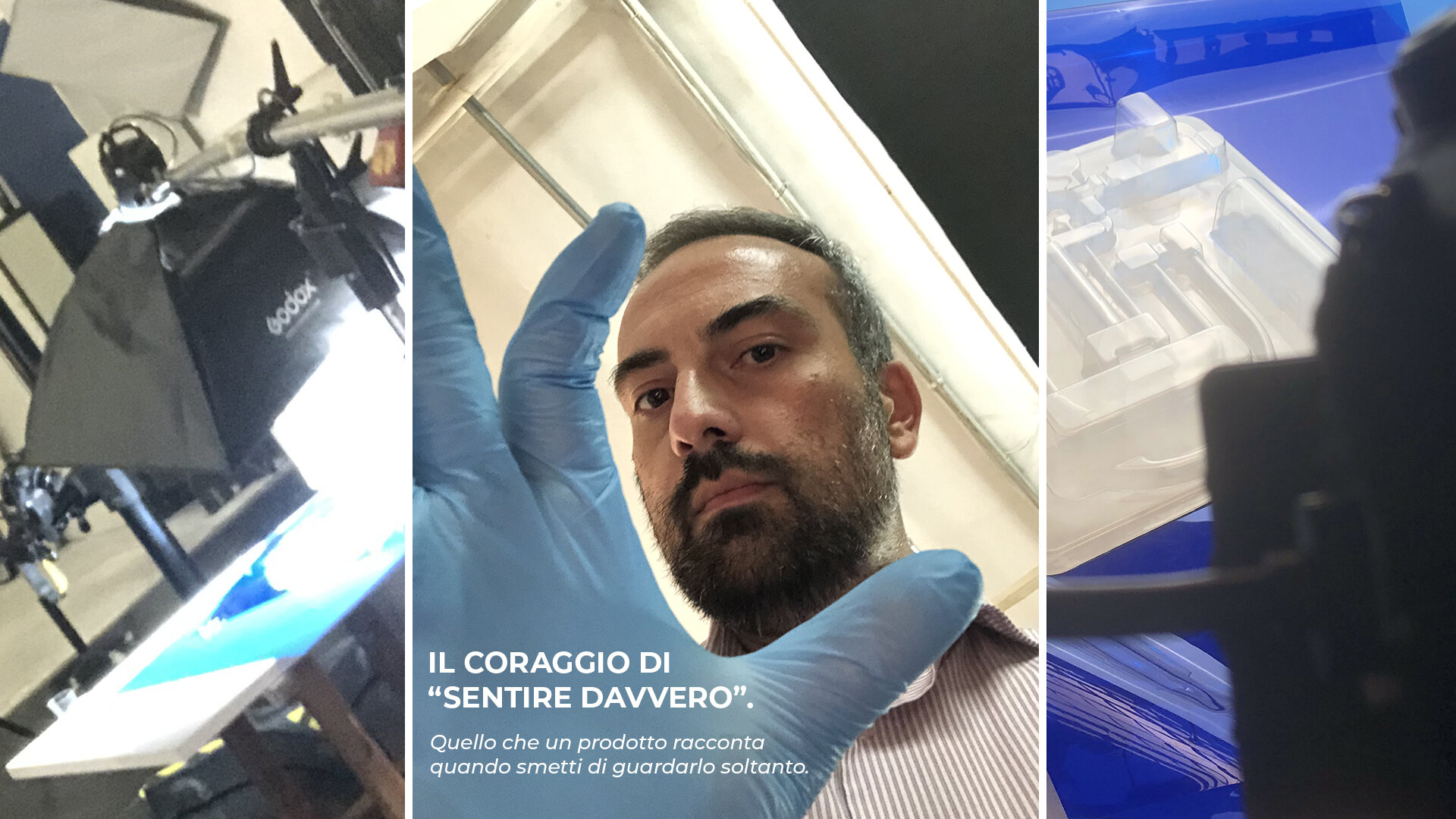
“Here… play with it a bit and then tell me.” In moments like this, a photograph stops being a snapshot and becomes a dialogue.
It happened a few days ago.
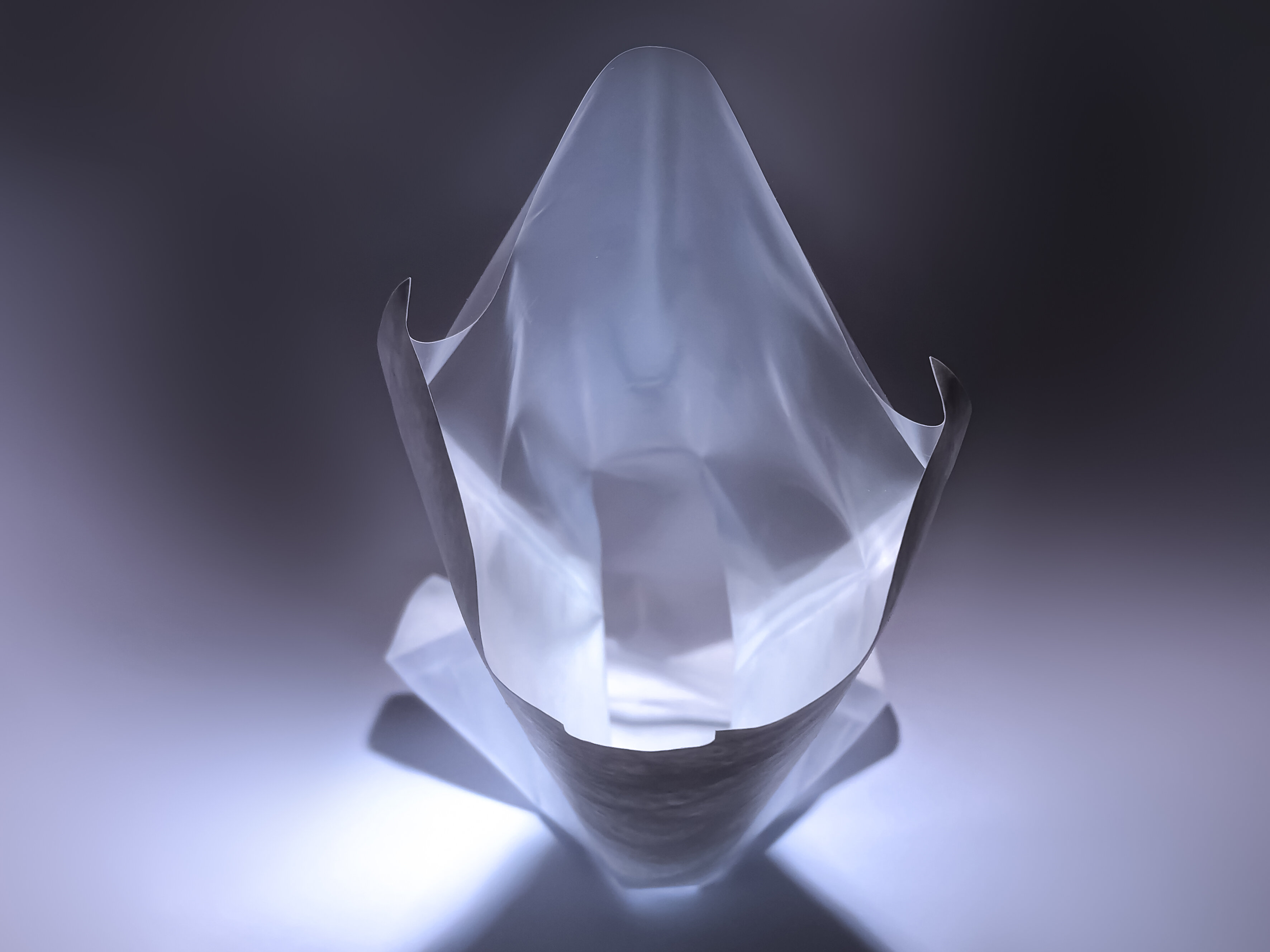
I had in my hands a transparent pouch, one of those “medical flexible packaging” items that, most of the time, we open-use and throw away… It was empty and open. Perfectly laid flat but also crumpled, wrinkled or dented.
No product inside. No “staged scene”. No artifice.
“Just a medical flexible package left there, on the surface, waiting for a reaction”. Just a sample ready to be… studied and listened to. And I “played” with it a little… I’d say a little... “a lot”.
The more I observed it, the more something happened that I know well: “the thing” stopped showing me what it was and started telling me “why it was”. And that’s a huge difference because almost everyone can describe an object, far fewer can understand it.
Understanding a product means accepting to slow down enough to let it question you, touch it, handle it, observe its tensions, its folds, its reactions, its marks… its resistance.
Understanding what happens when it is put under pressure… because it is precisely under pressure that things, but also people, Organizations, places and materials, reveal their nature.
And now, even that packaging: I began to look at its surfaces, the light running along the seals, I listened to the “dull” or sharp sound of the material that “tears” during opening WITHOUT EVER BREAKING or showing signs of giving way… and I understood that I was observing the result of hundreds of decisions.
Material, form and presence. Technique, perception and humanity: sensitivity is not the opposite of technique, it is what allows us to truly understand it.
Not a simple package but a sequence of choices.
Someone chose that material, defined its thickness, designed the barrier, studied that particular seal. Someone took on the responsibility of protecting something that, in turn, will have to protect someone else.
Suddenly I was no longer looking at a product but at personalities: that of the engineer, the designer, the technician/operator, the healthcare professional, even that of the final patient. All present… even if invisible.
Maybe this is what I mean when I talk about a humanistic approach: having the ability to transfer parts of ourselves into what we do (even into the product) with passion, intensity, vision. It doesn’t mean putting people at the center as a slogan, but recognizing that people are already inside things (in the form of choices, avoided mistakes, care for detail, in the intuition that works).
The packaging you see in the photo is born to protect: not (only) to close, not (only) to isolate, but to safeguard something so that it can arrive intact at the moment when it must be released.
It is a subtle and deeply human difference because we do the same thing too: we build skills, experiences, define boundaries, defenses, values… not to hold on to them forever but to give them back “at the right time”.
Observing that material I noticed something that struck me: it carried on it the signs of pressure, the traces of the journey, the inevitable tensions. Yet it kept doing its job… aesthetically “not perfect”, no longer immaculate… certainly “touched by events” but still impeccable and reliable.
And this, perhaps, is one of the most important lessons a material can teach: perfection does not always protect, while presence does.
The ability to remain faithful to one’s function. Integrity in keeping a promise.
How do you enter a product to communicate its essence?
Enter the material, the people, the problem it solves, the context of use, the emotions, the invisible details.
When I work on a product I always try to go beyond what I’m told.
Not to challenge the brief but to truly respect it (and tell it).... because a brief explains what a product does, the expectations and positioning intentions of the commissioning Company, while careful observation (active and participatory) tells why it exists.
And between these two moments of the same document (summary and observation)… there is a huge space that is often not made explicit.
Here stories are born (engaging).
Here the concept becomes photography (real).
Here understanding becomes content (verb).
And it is here that, often, I meet the most interesting part of my work, the part that does not consist in creating meanings but in recognizing those that were already present, in silence… always, waiting for someone to stop long enough to notice them.
Packaging is the concrete proof of a much bigger thesis: every product is a collective biography, a personal legacy compressed into matter.
Not only aesthetics, form, graphics, colors or image: when the project is approached with depth, packaging design becomes something very different… it becomes (also) an exercise in listening.
Because before drawing (and designing) a package you need to understand what that package will have to safeguard. You need to understand the nature of the product, its fragilities, its needs, its constraints, its responsibilities.
You need to understand the engineer’s language, production needs, market demands, the professional’s expectations, the fears and needs of the person who, one day, will find that product in their hands.
"If this product could speak, what would it be proud of?”
We must not only design a container but build a relationship, translate complexity, make visible what often remains invisible. Make worlds talk that normally "do not meet":
- technique with perception,
- function with emotion,
- safety with trust.
For this reason I believe that packaging design is, first of all, an act of sensitivity and responsibility… because sensitivity belongs not only to art but also to industry, to design, to those who can observe a material and understand that every reaction tells something, to those who can perceive the intelligence hidden behind a thickness, a barrier, a seal, a choice.
Sensitivity consists precisely in this: noticing that a product is a statement of intent, a clear and defined stance, a posture… a promise and, every promise, before being communicated, must be understood (and kept).
And maybe that’s why I keep photographing, observing, touching, listening to and questioning materials.
Because every time I manage to understand a product better, I also understand something more about the people who imagined it and, every time I understand those people, I can design, tell and communicate with greater truth.
And I learn because every product carries on it the character of those who imagined it: care or superficiality, courage or prudence, vision or confusion, attention or haste.
For this, when I find myself in front of a material I always try to read it deeply: a fold, a particular tension, a perfectly uniform seal, the shaping of a surface… all indicators for a correct reading of a material’s reaction to an action.
It is not very different from reading a person, a place, an Organization.
"Touching a product means feeling the Company that generated it” because "every product is a small narrative… the problem is that we stopped reading them."
Everything leaves traces. Everything communicates. Everything speaks. Even when it doesn’t use words.
But perhaps, looking at some Companies, we have stopped training this form of reading.
We scroll. We evaluate. We classify. We measure. But we read less and less.
Yet every profession that puts people at the center should start right here: from observation, from listening, from the ability to stay long enough in front of something to allow it to tell its story.
Because there is also a second movement: while we read the product, the product reads us, “measures” our attention, sensitivity, our ability to go beyond the surface.
It reveals how willing we are to understand before judging, how able we are to observe before interpreting,
how available we are to meet what is in front of us without pretending we already know everything.
It is a reciprocal relationship, an “exchange”, a “spontaneous contamination” and, perhaps, precisely for this… authentic.
The moment we stop looking only for answers and begin to accept that what we observe can also transform the way we look… we become true and credible.
Observation, identity and presence: reading a product means reading the people who thought it up and every time we learn to read a product better, we also learn something about our way of "being in the world" and of conceiving design: making reality readable.
Every design project is an act of translation: it transforms complexity into understanding. Every die-cut we develop is a symbolic system of its own, accepted, conventional and specific: it communicates (and makes explicit) the way in which that information will be read, understood and turned into action.
The product is an extension of the person, of their gestures and their vision… it establishes a connection that “exists and resists the passing of time”.
Because, in the end, “we are connectors by nature, insatiably curious, healthy carriers of stories”.